
The Reverse-Interview Playbook: 25 Questions to Spot Red Flags
Meta Description: Don't let an interview be one-sided. Use 25 high-signal reverse interview questions to uncover toxic culture, unclear roles, burnout risks, and leadership red flags.
Getting an interview invitation can feel like the hard part is over. But there is another decision you need to make: is this actually a company you want to work for?
An interview should not be treated as a one-way test where you simply prove that you deserve the job. You are evaluating the employer too.
That is where reverse interview questions for candidates become useful.
Instead of asking generic questions such as “What is the company culture like?”, ask questions that reveal how the organization actually handles failure, conflict, workload, priorities, leadership, and employee growth.
The goal is not to interrogate the interviewer. It is to conduct sensible professional due diligence before accepting an offer.
Why Reverse Interview Questions Matter
Almost every company can describe itself as innovative, collaborative, flexible, and employee-focused.
The more useful question is: What happens when reality becomes difficult?
How does leadership respond when a project fails? What happens when priorities suddenly change? Why did the previous employee leave? What happens when an employee challenges a senior decision?
These questions can reveal more than a polished careers page.
A strong reverse interview focuses on four areas:
Psychological safety and conflict
Resources and operational reality
Role clarity and success expectations
Leadership, strategy, and business stability
You do not need to ask all 25 questions. Pick the two or three that matter most for your situation and turn them into a conversation.
25 Reverse Interview Questions to Ask
1. Psychological Safety, Failure & Conflict
These questions help you understand how the company behaves when things go wrong.
1. “Can you tell me about the last major project that failed here? How did leadership respond?”
Listen for whether the company focuses on learning and accountability—or simply looks for someone to blame.
2. “When two senior leaders disagree on an important strategic decision, how is that conflict resolved?”
This can reveal whether disagreements are handled through evidence and discussion or through hierarchy and politics.
3. “Can you give me an example of feedback from a junior employee that led to an actual change?”
A specific example is much more valuable than a general claim about having an “open-door culture.”
4. “How does the team respond when an honest mistake causes production problems or customer friction?”
You are trying to understand the difference between accountability and a blame-oriented environment.
5. “When client or executive demands become unrealistic, how does leadership protect the team's capacity?”
The answer can tell you a lot about workload expectations and management boundaries.
6. “What happens when an employee disagrees with their manager’s decision?”
Look for evidence that respectful disagreement is possible without damaging someone's career.
2. Resources, Technical Debt & Operational Reality
A great job description cannot compensate for an under-resourced team.
7. “How much of the team's time currently goes toward fixing existing problems versus building new initiatives?”
For technical roles, this can expose the balance between technical debt and strategic development.
8. “What is the biggest operational bottleneck the team faces every week?”
A candid answer shows that the interviewer understands the team's actual problems.
9. “If I spoke privately with someone who joined six months ago, what frustration might they mention?”
This is one of the more revealing questions because it encourages the interviewer to acknowledge a real adjustment challenge.
10. “When an unexpected high-priority issue appears, how are existing priorities changed?”
Find out what gets deprioritized and who has the authority to make that decision.
11. “Are there tools, systems, or resources the team has requested but has not received?”
Repeated resource constraints can explain why otherwise capable teams struggle to deliver.
12. “What part of the current workflow would you fix first if budget and resources were not constraints?”
The answer can reveal problems that may not appear in the job description.
3. Role Origins, Expectations & Phantom Requisitions
Not every job opening has the same level of urgency or clarity.
13. “Is this a newly created position, or am I replacing someone?”
If it is a replacement, politely ask what happened to the previous person and how long they were in the role.
14. “If this position remains unfilled for the next 90 days, what business outcome is affected?”
A genuine business need usually has a reasonably clear consequence.
15. “What would make you say this hire has been highly successful after six months?”
Look for measurable outcomes rather than vague expectations such as “be proactive” or “fit into the team.”
16. “What has caused people in this role or department to struggle in the past?”
This question can expose unrealistic expectations, missing resources, management problems, or skill gaps.
17. “How is performance measured in this position?”
Ask whether success is connected to measurable outcomes, team objectives, customer results, or primarily subjective manager judgment.
18. “What are the top three priorities for this role during the first 90 days?”
A clear answer suggests the team has thought seriously about why it is hiring.
4. Leadership, Strategy & Business Stability
For senior positions, startups, and companies undergoing rapid change, these questions can be especially important.
19. “What is the biggest competitive threat the company is preparing for over the next two years?”
Strong leaders should have a reasonably clear view of the threats facing their business.
20. “How have recent market or technology changes affected this team's priorities and budget?”
This is particularly relevant in technology-heavy industries where AI and automation are rapidly changing workflows.
21. “What was one difficult strategic decision leadership made recently, and what did the company learn from it?”
You are looking for evidence of reflection rather than a claim that every decision has worked perfectly.
22. “Where does this department sit among the company's strategic priorities?”
Knowing whether your team is considered core, supporting, experimental, or cost-focused can affect resources and career opportunities.
23. “What is the biggest business assumption the leadership team is currently testing?”
This can reveal whether executives are actively thinking about uncertainty instead of pretending everything is predictable.
24. “What has changed most significantly in the company since this role was originally approved?”
This can uncover whether the role has evolved, been deprioritized, or become something different from the original job description.
25. “If you could change one thing about how this company operates today, what would it be?”
This simple question often produces a more honest answer than asking whether the company has any weaknesses.
Generic Questions vs. High-Signal Questions
The difference is not about sounding clever. It is about asking questions that produce useful evidence.
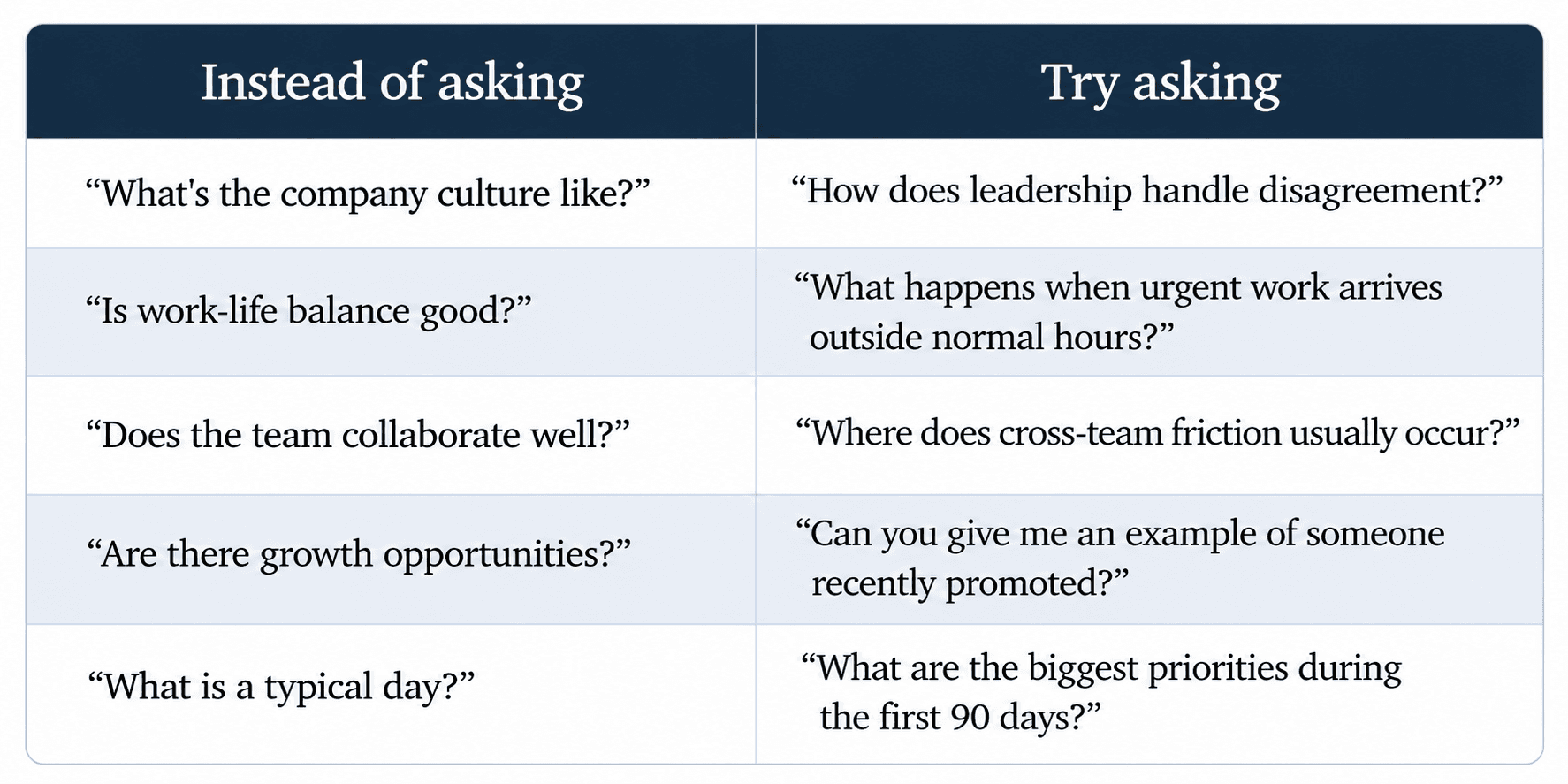
The best questions force the conversation away from slogans and toward examples.
How to Recognize Red Flags in the Answers
Pay attention to more than the words themselves.
Vague answers about the previous employee
If nobody can clearly explain why the previous person left, what they achieved, or what the company learned, ask a respectful follow-up.
Conflicting answers
If one interviewer describes the position as strategic while another describes it as mostly operational firefighting, the role may not be clearly defined.
No concrete examples
If every answer sounds polished but nobody can provide a real example, treat that as a signal to investigate further.
Constant emphasis on sacrifice
Statements about needing people who are “always available,” “extremely committed,” or willing to “do whatever it takes” may indicate expectations that deserve clarification.
A single red flag does not automatically mean you should reject a company. Patterns matter more than isolated signals.
How Many Questions Should You Ask?
You do not need to ask all 25.
For a final interview, choose two or three high-priority questions based on what matters most to you.
For example:
Concerned about burnout? Ask about workload and after-hours expectations.
Joining a startup? Ask about strategy, priorities, and resources.
Taking a technical role? Ask about technical debt and operational bottlenecks.
Replacing someone? Ask why the previous employee left and how success will be measured.
The quality of the conversation matters more than the number of questions.
What If the Interviewer Is the CEO or Founder?
When speaking with a CEO or founder, move toward questions about strategy, customers, competition, and organizational priorities.
You could ask:
“What is the biggest operational lesson you have learned while scaling the company?”
Or:
“What makes you confident the company can maintain its competitive advantage over the next few years?”
The goal is not to challenge the founder. It is to understand how leadership thinks.
Final Takeaway
A job interview is also your opportunity to evaluate the employer.
The right questions to ask a hiring manager to spot red flags can help you understand the workplace before you commit to it. Instead of accepting broad statements about culture, ask for examples. Instead of asking whether the team is busy, ask how priorities change when emergencies appear. Instead of asking whether there is career growth, ask how someone was actually promoted.
You are not looking for a perfect company. No company is perfect.
You are looking for a company whose problems, expectations, leadership style, and working environment are compatible with what you want from your career.
That is the real purpose of reverse interviewing.
Frequently Asked Questions
What are the best reverse interview questions for candidates?
The best questions uncover how a company handles failure, conflict, workload, priorities, performance, leadership, and employee growth. Questions that ask for specific examples are generally more informative than broad questions about culture.
How can I ask questions that reveal a toxic work culture?
Ask how leadership handles disagreement, mistakes, after-hours work, unrealistic deadlines, and feedback from junior employees. Look for specific examples rather than polished descriptions.
How many questions should I ask in an interview?
Two or three strong questions are usually enough during a final interview. Choose questions based on your biggest concerns about the role and company.
Should I ask why the previous employee left?
Yes, when appropriate. You can ask whether the role is new or a replacement and, if it is a replacement, what the company learned from the previous hire's experience.
What should I ask a CEO in a final interview?
Focus on company strategy, competitive threats, lessons learned, major priorities, and the organization's future direction. The goal is to understand how leadership thinks about the business.
Can reverse interview questions actually help identify a bad employer?
They can help you uncover warning signs, but no single answer proves that a company is toxic or poorly managed. Use the interview answers alongside independent research, conversations with current or former employees, and your overall experience throughout the hiring process.