

German Employment Contracts Explained: A Guide for Expats
Receiving a job offer in Germany is an exciting milestone, but signing your employment contract requires more than checking your salary. Your Arbeitsvertrag defines important aspects of your working relationship, including responsibilities, working hours, probation, notice periods, paid leave, and additional benefits.
For international professionals relocating from countries such as the United States, the United Kingdom, or India, German employment rules can feel unfamiliar. Terms such as Probezeit, Kündigungsfrist, and Wettbewerbsverbot may appear throughout the contract, and misunderstanding them can create problems later.
This guide explains the key clauses to review before signing a German employment contract, what statutory protections generally apply, and when professional legal advice may be worthwhile.
1. Understanding the German Arbeitsvertrag
An Arbeitsvertrag is an employment agreement governed by German law. It can be written in German or another language, but you should understand the terms and any applicable language-precedence clause before signing.
German employment law provides important employee protections, although these protections depend on the circumstances and the specific law involved. Germany does not have a general US-style at-will employment system.
Before accepting an offer, check the following:
Job responsibilities: Your position, reporting line, and principal duties.
Compensation: Gross salary, bonuses, commission, and equity arrangements.
Working hours: Weekly hours, overtime arrangements, and applicable breaks.
Probation: Whether a probationary period applies and how long it lasts.
Notice periods: The notice required to end employment.
Leave and benefits: Annual leave, sick pay, insurance, and additional benefits.
Special clauses: Confidentiality, secondary employment, intellectual property, and non-compete restrictions.
German employers must provide essential employment conditions in accordance with the German Verification Act (Nachweisgesetz). Check the applicable documentation requirements rather than assuming every contract must follow the same format.
2. Probezeit: How Probation Works in Germany
Probezeit is the probationary period during which an employer evaluates your suitability for the role.
Under Section 622(3) of the German Civil Code (BGB), an agreed probationary period can last up to six months for the special statutory two-week notice rule.
During this period, either party can generally terminate the employment relationship with two weeks' notice, unless an applicable collective agreement provides otherwise.
However, probation does not mean employees have no legal rights. Other protections may still apply, and specific circumstances can affect whether a termination is lawful.
For expats holding an EU Blue Card or another residence permit tied to employment, losing a job can also affect immigration planning. Contact the relevant immigration authority promptly to understand your reporting obligations, residence status, and options for finding another qualifying position.
3. Kündigungsfrist: Understanding Notice Periods
Kündigungsfrist means the notice period required to terminate an employment relationship.
Under Section 622 BGB, the general statutory notice period for employees is four weeks, effective on the 15th or the end of a calendar month. The employer's statutory notice period generally increases with the employee's length of service, reaching seven months to the end of a calendar month after 20 years.
Contracts and collective agreements may contain different arrangements, subject to applicable legal requirements.
For example, your contract might require three months' notice to the end of a calendar quarter. Depending on the wording, this can significantly affect when you can start another job.
Before signing, confirm:
Whether the notice period differs during probation.
Whether longer notice periods apply after probation.
Whether the same contractual period applies to both parties.
Whether a collective agreement affects the terms.
How notice must be delivered.
German law generally requires termination notices to be in written paper form with a valid signature; electronic form is excluded under Section 623 BGB. An email or PDF alone is generally insufficient.
Review the official English translation of the German Civil Code for the statutory provisions.
4. Overtime Clauses: What You Should Check
Some employment contracts contain broad clauses stating that all overtime is covered by the agreed salary. Such wording deserves careful review.
German law does not make every overtime clause automatically invalid. However, blanket clauses can be ineffective when employees cannot reasonably determine how much additional work is included in their compensation.
Before signing, clarify:
Your contractual weekly working hours.
Whether overtime requires prior approval.
Whether overtime is paid or compensated with time off.
Whether the contract specifies a clear limit on included overtime.
Whether special arrangements apply to your position.
Also check the applicable Working Hours Act (Arbeitszeitgesetz). As a general rule, working time is limited to eight hours per working day, with extensions to ten hours permitted under specified conditions when the statutory averaging requirements are met.
Do not assume that a senior job title automatically exempts you from working-time protections.
5. Post-Contractual Non-Compete Clauses
A nachvertragliches Wettbewerbsverbot restricts certain competitive activities after employment ends.
These clauses can affect your ability to join another company, start a business, or work with particular clients. They should therefore be reviewed before you accept the contract.
Under Sections 74 and 74a of the German Commercial Code (HGB), applicable employee non-compete agreements generally require written documentation and compensation of at least half the relevant previous contractual remuneration for each year of the restriction. The restriction must also satisfy other legal requirements, including limits on duration and legitimate business interests.
A post-contractual restriction generally cannot exceed two years.
The exact legal consequences of a defective clause depend on its wording and circumstances. Do not assume that every problematic clause automatically disappears or that you can safely ignore it.
Read the official English translation of the German Commercial Code and seek employment-law advice if a clause could limit your next career move.
6. Paid Vacation and Sick Pay
German employment law establishes minimum entitlements for annual leave and continued remuneration during qualifying periods of illness.
Annual paid leave
Under the Federal Leave Act (Bundesurlaubsgesetz), the statutory minimum is 24 working days per year for a six-day working week. This is equivalent to 20 days for a five-day working week.
Many employers offer more generous annual leave, but additional days are contractual benefits rather than a universal statutory minimum.
Check the number of leave days, public holiday arrangements, carry-over rules, and any special provisions in your contract.
Sick pay
Under the Continued Remuneration Act (Entgeltfortzahlungsgesetz), eligible employees generally receive continued remuneration from their employer for up to six weeks of illness, subject to statutory conditions.
The entitlement usually requires the employment relationship to have existed continuously for at least four weeks. After the employer's continued-payment obligation ends, eligible members of statutory health insurance may qualify for sickness benefit (Krankengeld).
Notify your employer promptly when illness prevents you from working and follow the applicable medical certification requirements.
7. Employment Contract Comparison: What Expats Should Know
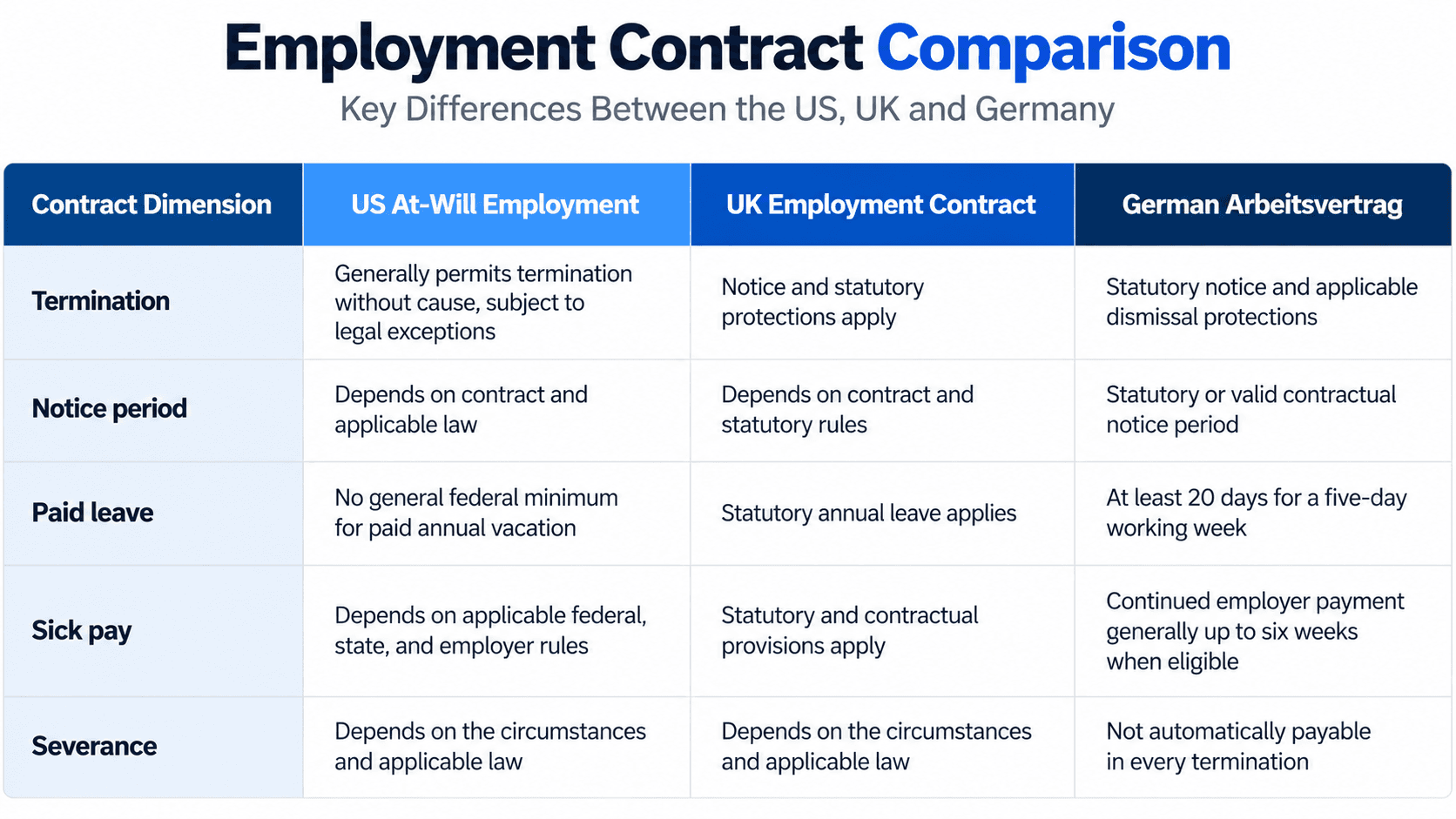
This comparison is a general overview, not a substitute for reviewing the laws that apply to your individual employment.
8. Common Contract Mistakes Expats Should Avoid
Ignoring the job-seeker registration deadline: If you learn that your employment will end less than three months in advance, you generally must register as a jobseeker with the Federal Employment Agency within three days of learning the end date. Register earlier when possible to avoid potential benefit disadvantages.
Signing a mutual termination agreement without advice: An Aufhebungsvertrag can have consequences for unemployment benefits, notice rights, and immigration status. Seek advice before agreeing to its terms.
Relying on verbal promises: Ensure important commitments about bonuses, relocation assistance, remote work, and equity are documented clearly.
Overlooking secondary employment rules: Review any Nebentätigkeit clause before accepting freelance work or starting a side business. Employers may have legitimate grounds to restrict certain activities, but approval requirements and restrictions must be assessed in context.
For additional relocation information, explore the UNIBLIP Germany Hub.
9. Frequently Asked Questions
Can my employer dismiss me after probation?
Yes, but applicable notice requirements and dismissal protections still matter. The Dismissal Protection Act (Kündigungsschutzgesetz) generally applies after more than six months of employment where the relevant establishment-size requirements are met, subject to statutory exceptions.
Is an English employment contract valid in Germany?
An English-language employment contract can be legally valid. Read any language-precedence clause carefully and make sure you understand all terms before signing.
Can I freelance while working full-time?
It depends on your contract, the nature of the activity, working-time rules, conflicts of interest, and your immigration status where relevant. Check these factors before starting a side business.
Should I consult a German employment lawyer before signing?
Consider legal advice if the contract contains a restrictive non-compete, complex bonus or equity terms, substantial repayment obligations, unusual notice periods, or provisions you do not understand.
Conclusion
Understanding your German employment contract before signing can help you make better decisions about your salary, working conditions, job security, and future career plans.
Pay particular attention to probation, notice periods, overtime, post-contractual restrictions, annual leave, and sick pay. If you are relocating to Germany, also review how a potential job change could affect your residence permit.
A careful contract review is a practical step toward starting your new role with greater confidence and fewer surprises.
Explore more: Visit the UNIBLIP Germany Hub for additional relocation and expat resources.