
Staff Engineer Archetypes: 4 Paths to Staff+ Without Burning Out
Moving from Senior Software Engineer to Staff Engineer is one of the most challenging transitions in a technical career. At the senior level, success often comes from delivering complex projects independently. At the Staff level, the expectation expands: you must influence technical decisions, help multiple engineers succeed, and solve problems that extend beyond your immediate team.
However, there is no single way to become an effective Staff Engineer.
In Staff Engineer: Leadership Beyond the Management Track, Will Larson describes four common Staff Engineer archetypes: Tech Lead, Architect, Solver, and Right Hand. Each represents a different way to create technical and organizational impact.
Understanding these archetypes can help you identify your strengths, choose suitable projects, and build a more sustainable staff software engineer career path.
Why the Senior-to-Staff Transition Is Difficult
Senior engineers are generally expected to own substantial projects, make sound technical decisions, and deliver reliable software. Staff Engineers must extend that impact across teams, systems, or organizational boundaries.
Simply writing more code or taking on additional tasks does not automatically demonstrate Staff-level performance.
Instead, organizations often look for evidence of broader influence, sound technical judgment, effective collaboration, and measurable outcomes.
For example, a Senior Engineer might optimize a database query for one application. A Staff Engineer might identify a recurring performance problem across several services and introduce a shared solution that improves reliability for multiple teams.
The difference is not that coding becomes unimportant. It is that the scope of the problem and the impact of the solution become larger.
The 4 Staff Engineer Archetypes Explained
1. The Tech Lead
The Tech Lead focuses on technical execution and helps a team or group of closely connected teams deliver complex projects successfully.
Typical responsibilities include:
Establishing technical direction for major projects.
Breaking complex work into manageable milestones.
Reviewing important design decisions and code.
Mentoring engineers and resolving technical blockers.
Coordinating with engineering managers and product managers.
A Tech Lead stays close to implementation while ensuring that individual engineering decisions support the larger project.
Example: A company is rebuilding its payment system. The Tech Lead defines the implementation approach, coordinates dependencies, evaluates trade-offs, and helps engineers deliver the system safely.
Best suited for: Engineers who enjoy hands-on technical work, collaboration, mentoring, and leading execution.
2. The Architect
The Architect focuses on the long-term technical direction of a system, platform, or major product area.
Rather than optimizing only for the next release, this archetype considers scalability, reliability, security, maintainability, and the impact of technical decisions across teams.
Typical responsibilities include:
Defining architectural principles and system boundaries.
Evaluating technologies and major infrastructure decisions.
Developing design proposals and technical standards.
Aligning teams around shared APIs and interfaces.
Identifying and reducing systemic technical debt.
Example: Several engineering teams have built separate services for similar business functions. An Architect develops a shared technical approach that reduces duplication without unnecessarily restricting each team's independence.
Best suited for: Engineers who enjoy system design, complex trade-offs, technical strategy, and long-term problem-solving.
An important lesson: architecture documents alone do not demonstrate impact. The recommendations must address real needs and be adopted successfully.
3. The Solver
The Solver specializes in difficult, ambiguous, or high-risk technical problems that require deep investigation.
This archetype is particularly valuable when conventional debugging methods are insufficient or when a critical issue affects multiple systems.
Typical responsibilities include:
Investigating complex production incidents.
Diagnosing performance bottlenecks and distributed systems failures.
Resolving difficult concurrency or reliability problems.
Leading technically challenging migrations.
Documenting root causes and preventing similar incidents.
Example: A high-traffic application experiences unpredictable latency. The Solver investigates database behavior, traces requests across services, identifies the underlying bottleneck, and develops a solution that improves system performance.
Best suited for: Engineers who enjoy deep technical investigation, debugging, experimentation, and solving problems with unclear answers.
The risk is becoming the person everyone calls whenever something breaks. A strong Solver also develops tools, documentation, and preventive systems so that other engineers can handle similar problems in the future.
4. The Right Hand
The Right Hand works closely with a senior technical leader, such as a CTO, VP of Engineering, or Head of Infrastructure, to turn organizational priorities into effective engineering decisions.
This archetype requires technical credibility as well as strong communication, judgment, and cross-team influence.
Typical responsibilities include:
Clarifying complex technical trade-offs for leadership.
Coordinating initiatives that span multiple teams.
Resolving disagreements over technical priorities.
Helping translate company strategy into engineering plans.
Identifying organizational obstacles that affect delivery.
Example: A company needs to consolidate infrastructure across several departments. The Right Hand helps leadership understand the technical options, coordinates the teams involved, and develops a practical implementation plan.
Best suited for: Engineers who enjoy strategic problem-solving, organizational alignment, executive communication, and navigating complex dependencies.
The role is not simply administrative support. Its value comes from combining technical understanding with the ability to help an organization make better decisions.
Comparing the Four Archetypes
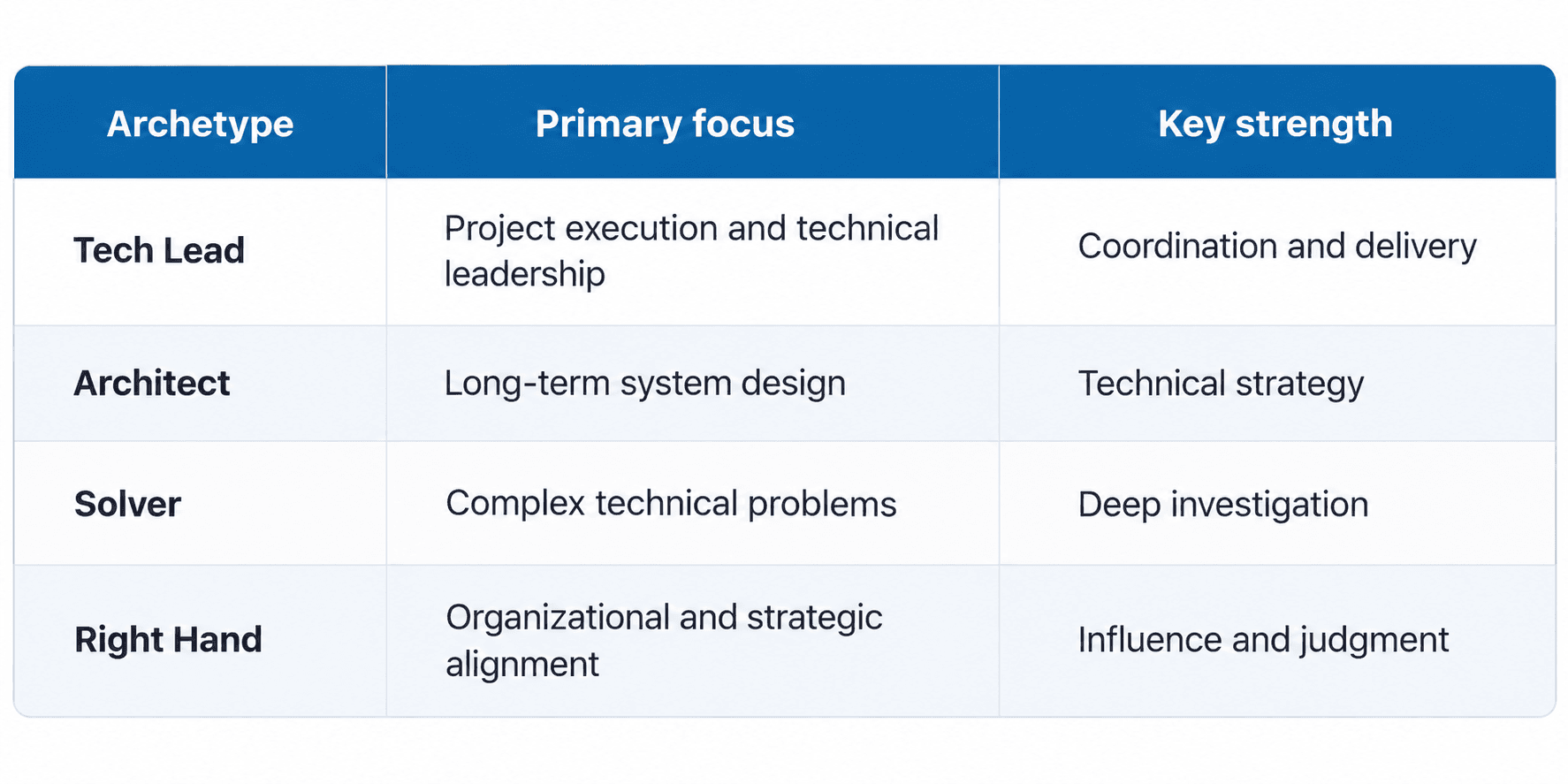
These archetypes are not rigid job descriptions. An engineer may combine them or move between them as project requirements and organizational needs change.
Coding expectations also vary by company, role, and project. None of these archetypes should be defined by a universal percentage of time spent coding.
How to Choose the Right Staff Engineer Path
Start by examining the problems you naturally gravitate toward.
If you enjoy guiding teams through complex implementations, explore the Tech Lead path.
If you prefer designing systems that multiple teams can use, consider the Architect path.
If difficult technical investigations motivate you, explore the Solver path.
If you enjoy connecting technical decisions with organizational priorities, consider the Right Hand path.
Next, evaluate your company's needs. A growing organization may need better shared architecture, while another may struggle with reliability, execution, or cross-team coordination.
Your preferred archetype should align with both your strengths and problems that matter to the business.
Most importantly, discuss expectations with your manager. Staff-level responsibilities and promotion criteria differ between organizations, so understand the specific engineering ladder used by your company.
Common Mistakes That Can Delay Promotion
1. Doing more work without increasing impact
Taking on additional tickets can keep you busy without demonstrating broader responsibility. Prioritize problems whose solutions benefit teams, systems, or business outcomes.
2. Designing without securing adoption
A technically elegant proposal has limited value if teams cannot implement it or see no reason to adopt it. Involve stakeholders early and account for practical constraints.
3. Becoming the permanent problem-solver
Repeatedly fixing every incident creates dependency on you. Build reusable tools, document solutions, and mentor others to increase the team's independence.
4. Failing to document results
Record the problem, your decisions, the people or systems affected, and the measurable outcome. Examples might include reduced incident frequency, lower infrastructure costs, or shorter deployment times.
5. Assuming promotion is automatic
Strong performance alone does not guarantee promotion. Ask your manager for specific expectations, seek feedback from Staff-level peers, and agree on a realistic development plan.
Frequently Asked Questions
Can I change Staff Engineer archetypes during my career?
Yes. These archetypes describe different patterns of impact rather than permanent job categories. You might lead a major project, design a shared platform, and later investigate a difficult reliability issue.
How can I get promoted to Staff Engineer?
Understand your company's promotion criteria, identify a problem with broader organizational impact, build support across teams, and demonstrate measurable results. Work with your manager to review progress regularly.
Does a Staff Engineer stop writing code?
No. Coding remains valuable when it helps validate designs, solve difficult problems, develop foundational tools, or improve systems. The balance between implementation and other responsibilities depends on the role.
What evidence demonstrates Staff-level impact?
Useful evidence includes successful cross-team initiatives, adopted technical standards, measurable reliability improvements, reduced operational costs, and examples of enabling other engineers to work more effectively.
Final Thoughts
Becoming a Staff Engineer is not about choosing the most prestigious title or working longer hours. It is about understanding where your technical strengths create the greatest impact.
Will Larson's four archetypes offer a useful framework for thinking about that impact. Whether you lead execution, shape architecture, solve difficult technical problems, or connect engineering strategy with organizational priorities, the goal is to solve important problems in ways that extend beyond your individual output.
Choose a direction that fits your strengths, understand what your organization needs, and build a track record of outcomes that others can recognize and verify.
Explore more career development resources in the UNIBLIP Career Growth Hub.