
You know that feeling when your current job isn't terrible — but it isn't exciting anymore either?You've learned the role. You know the systems. Your colleagues know you. Your manager trusts you.
But somewhere in the back of your mind, there's a question:
“Is this where my career is going, or am I simply staying because it's comfortable?”
Then another company posts a job that looks interesting.
Better salary. Bigger title. New challenges.
Suddenly, you're stuck between two choices:
Stay and try to grow where you are — or leave and start somewhere new?
There is no universal answer.
Sometimes an internal promotion is the smartest career move. Other times, staying too long can quietly limit your growth.
The key is to stop making the decision based on fear, comfort or frustration.
Instead, ask yourself these six questions.
1. What Do You Actually Want From Your Career?
Before deciding whether to stay or leave, define what you're trying to achieve.
Do you want:
A higher salary?
A leadership position?
New skills?
More flexibility?
A different industry?
Greater responsibility?
Better work-life balance?
A completely different career direction?
Your answer matters because different goals require different moves.
If your current company has a clear path toward the position you want, an internal promotion could make sense.
But if your goal requires a completely different environment, industry or type of experience, changing companies may get you there faster.
Don't choose the move first. Choose the destination first.
2. Is Your Company Actually Creating Opportunities?
Here's an uncomfortable truth:
You can be an excellent employee and still have nowhere to go.
Imagine your manager has been in their position for eight years and has no plans to leave. The manager above them isn't going anywhere either.
Even if you're performing brilliantly, there may simply be no opening.
Look at the company's direction.
Is the organisation growing?
Are new teams being created?
Are employees being promoted?
Are senior people moving into new positions?
Or does everything feel stuck?
A growing organisation can create opportunities that didn't exist before.
A stagnant structure can do the opposite.
If the ladder has no next step, it may be time to look outside.
3. Does Your Company Recognise What You're Capable Of?
This question can be difficult because sometimes the problem isn't your performance.
It's visibility.
Maybe you've taken on responsibilities beyond your job description. You've solved problems, helped teammates and delivered strong results — but you're still being treated exactly like you were two years ago.
Pay attention to what happens next.
Are you being given meaningful responsibilities?
Are you receiving useful feedback?
Are you being considered for bigger projects?
Does your manager talk to you about career development?
One particularly strong warning sign is when the company repeatedly hires externally for positions you're already capable of doing.
That doesn't automatically mean you should quit.
But it does mean you should ask:
“What would I need to demonstrate to be considered for that next role?”
If the answer is vague — or there is no realistic path — an external move may deserve serious consideration.
4. Where Will You Learn More?
Career growth isn't only about titles.
Sometimes the best move is the one that gives you the strongest learning opportunity.
Look at your current company.
Can you access:
Training?
Mentorship?
Challenging projects?
Cross-functional experience?
Leadership opportunities?
New technology or tools?
Support for professional development?
If yes, staying for another year may dramatically strengthen your experience.
But if you've stopped learning and every week feels identical, that's different.
You don't want to change jobs simply because you're bored.
But you also don't want to stay somewhere for years while your skills stop developing.
Ask yourself:
“Will this environment make me more valuable two years from now?”
If the answer is yes, staying may be a strategic decision.
If the answer is no, start exploring your options.
5. Does the Company Still Fit You?
Sometimes a company can be good — and still be wrong for you.
Maybe you joined because you wanted stability, but now you want faster growth.
Maybe you enjoy the people but dislike the highly structured environment.
Maybe you thrive in a fast-moving startup, while your current organisation is extremely process-driven.
Or perhaps your priorities have changed.
The person who accepted your current job two or three years ago isn't necessarily the same person making today's decision.
Think about your values, personality and preferred working style.
Ask:
“If I joined this company today, knowing what I know now, would I still choose it?”
If the honest answer is no, don't ignore it.
6. Are You Ready for Either Option?
Here's the smartest approach:
Don't wait until you decide to leave before becoming prepared to leave.
That doesn't mean constantly applying for jobs.
It means keeping your career options open.
Internally:
Track your achievements.
Ask for feedback.
Build relationships with decision-makers.
Take relevant training.
Volunteer for meaningful projects.
Externally:
Keep your CV updated.
Maintain your LinkedIn profile.
Build your professional network.
Follow companies you're interested in.
Keep an eye on relevant opportunities.
The goal isn't to become obsessed with job hunting.
It's to avoid becoming dependent on one option.
When you're prepared for both paths, you make decisions from choice rather than desperation.
So, Should You Stay or Leave?
Use this simple framework:
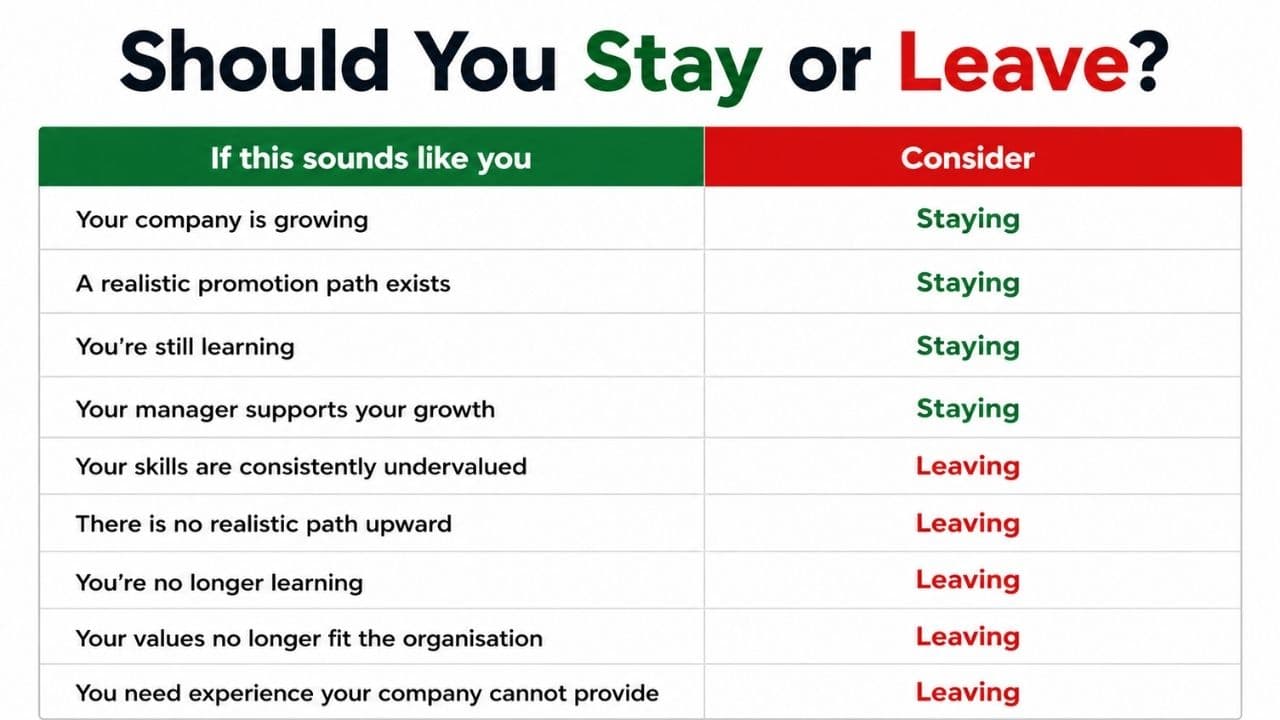
But don't treat this as a rigid formula.
Sometimes the answer is neither.
You might stay temporarily while building skills and searching for the right external opportunity.
That's still a career strategy.
The Best Career Move Is the One That Creates Progress
Leaving your company isn't automatically ambitious.
Staying isn't automatically loyal.
The right choice is the one that moves you closer to the career you actually want.
Before making your decision, ask yourself:
Am I staying because there is genuine opportunity here — or because leaving feels uncomfortable?
And if you're thinking about leaving:
Am I leaving because this opportunity is genuinely better — or simply because I'm frustrated right now?
Those two questions can save you from making a decision you'll regret.
Your career doesn't need constant movement.
It needs intentional movement.
Sometimes that means accepting the promotion you've worked for.
Sometimes it means changing companies.
And sometimes it means staying exactly where you are for a little longer — but with a clear plan for what's next.
Don't ask, “Should I stay or go?”
Ask the better question:
“Which choice gives me the strongest opportunity to grow from where I am to where I want to be?”
That's where your next career move begins.
