
The room is full of people.
Everyone seems to know someone.
A few groups are already talking, laughing and exchanging LinkedIn profiles.
You stand near the coffee table, checking your phone and thinking:
“Who am I supposed to talk to?”
If you've ever felt this way at a networking event, you're not alone.
For many people, networking sounds simple in theory. Walk into a room, introduce yourself, make conversation and exchange contacts.
In reality, it can feel awkward, intimidating and exhausting — especially if you're naturally shy or more comfortable in smaller conversations.
But here's something worth remembering:
You don't have to become the loudest person in the room to become good at networking.
You simply need to learn how to start conversations, show genuine interest and stay in touch afterwards.
Networking isn't about collecting as many contacts as possible.
It's about building relationships that can become useful, supportive and meaningful over time.
Here are three practical networking tips for introverts and anyone who feels uncomfortable walking up to strangers.
1. Start With a Low-Pressure Conversation
The hardest part of networking is often the first few seconds.
You see someone standing alone and immediately start thinking:
“What should I say?”
The good news is that you don't need a brilliant opening line.
Look for a natural reason to start talking.
Instead of walking across a crowded room and introducing yourself out of nowhere, use the situation around you.
For example:
“Have you attended this event before?”
“Which session are you most interested in?”
“What brought you to this event?”
“Have you heard this speaker before?”
These questions work because you're talking about something you already have in common: the event you're both attending.
You can also start small.
Build Your Networking Confidence Gradually
Don't force yourself to approach ten complete strangers at your first event.
Try this instead:
Step 1: Talk to someone you already know.
Step 2: Talk to someone introduced by a colleague or friend.
Step 3: Start a conversation with someone you've never met.
This gradual approach makes networking feel less like a performance and more like a skill you're practising.
And remember:
Confidence usually comes after action, not before it.
2. Ask Better Questions Instead of Trying to Impress People
A common networking mistake is worrying too much about what you're going to say about yourself.
You don't need to deliver a perfect elevator pitch.
Instead, become curious.
People generally enjoy talking about their experiences, work and interests when the questions feel genuine.
Try asking:
“How did you get into this industry?”
“What do you enjoy most about your work?”
“What brought you to this event?”
“What's changing in your industry right now?”
“What advice would you give someone starting out?”
Then actually listen to the answer.
Don't immediately think about what you're going to say next.
Listen for something you can build on.
If someone says they recently changed industries, you might ask:
“What made you decide to make the switch?”
If they mention a project they're excited about:
“What's been the most challenging part of it?”
That's how a short introduction becomes a real conversation.
Move Beyond Work When It Feels Natural
Once you've established some professional connection, you can move into lighter topics.
You might ask about:
Restaurants nearby
Books or films
Travel
Hobbies
Local events
The goal isn't to interrogate someone.
It's to find common ground.
Good networking feels like a conversation, not a job interview.
3. Follow Up — That's Where Networking Really Begins
You had a great conversation.
You exchanged LinkedIn details.
Then you went home.
Three weeks later, you see their name in your contacts and can't remember what you talked about.
This is where many networking opportunities disappear.
The event itself is only the beginning.
The real relationship develops afterwards.
Try to follow up within a day or two while the conversation is still fresh.
Don't send a generic:
“Nice to meet you. Let's connect.”
Mention something specific.
For example:
“Hi Sarah, it was great meeting you at the marketing event yesterday. I really enjoyed our conversation about the shift toward AI in content creation. Thanks again for recommending that podcast — I'm going to check it out this weekend. I'd love to stay connected.”
It's short.
It's personal.
And most importantly, it shows that you actually remember the conversation.
Don't Ask for a Job Immediately
This is especially important.
Networking isn't about meeting someone today and asking them for an opportunity tomorrow.
Build the relationship first.
Share something useful.
Congratulate them on a professional achievement.
Comment thoughtfully on something they post.
Reconnect occasionally.
Over time, a contact can become a mentor, collaborator, referral source, client or friend.
You never know where a genuine professional relationship might lead.
What If You Still Feel Awkward?
You probably will.
That's normal.
Even confident professionals sometimes feel uncomfortable walking into a room full of strangers.
Don't make “feeling confident” your requirement for networking.
Make taking one small action your goal.
Instead of:
“I need to meet ten people tonight.”
Try:
“I'm going to have one meaningful conversation.”
That's much easier.
Once that conversation is over, have another if you feel comfortable.
Over time, your comfort zone expands.
And you may discover something surprising:
You weren't actually bad at networking.
You were simply trying to do too much, too quickly.
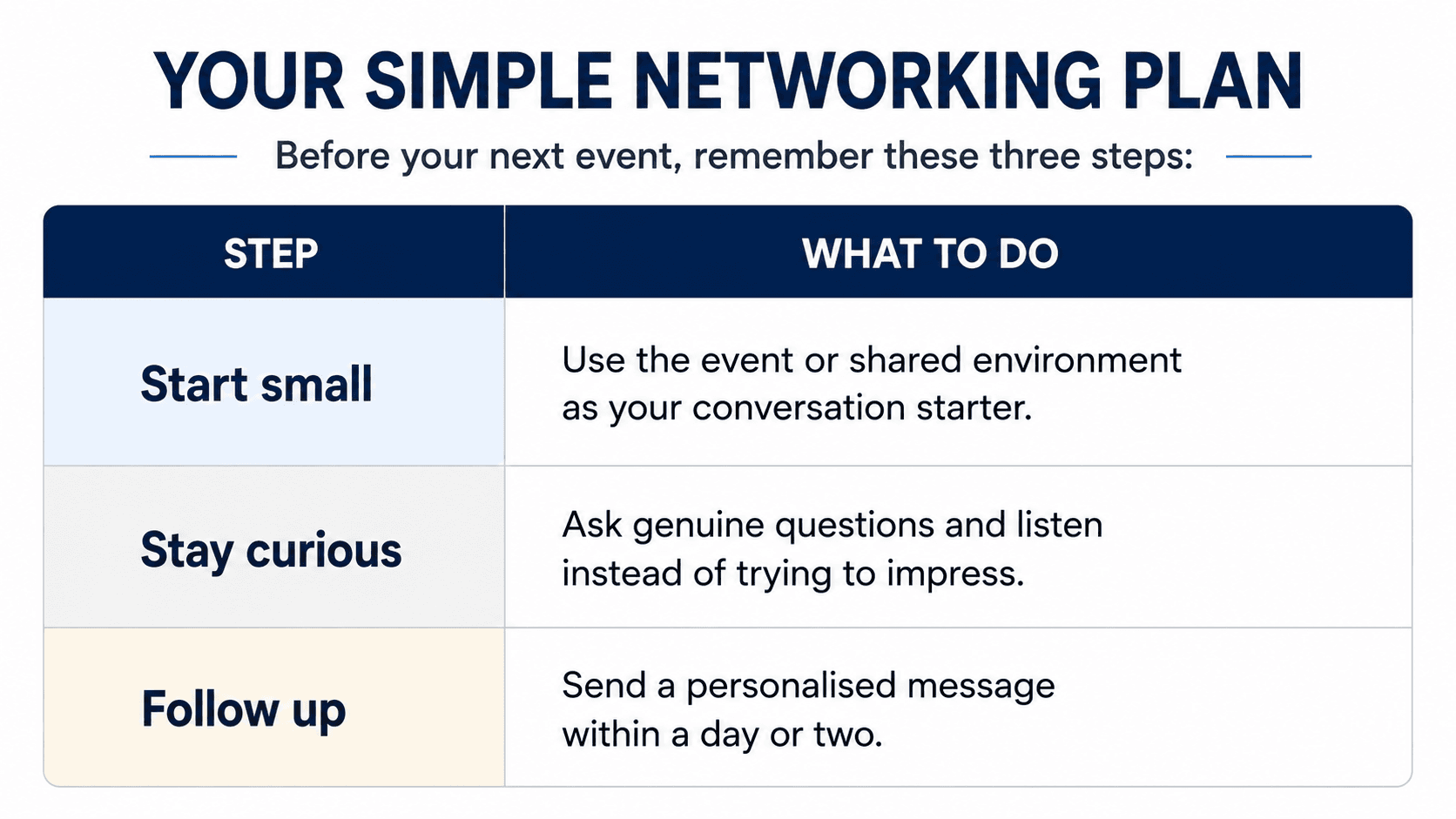
Your Simple Networking Plan
Before your next event, remember these three steps:
You don't need hundreds of connections.
You don't need to become an extrovert.
And you don't need to walk into every room feeling fearless.
You just need to be willing to start one conversation.
Because your next opportunity might not come from the job board.
It might come from a person you met while waiting for coffee.
So the next time you walk into a networking event and feel that familiar hesitation, don't look for the perfect person to impress.
Look for one person to talk to.
That's enough to begin.