

From Software Engineer to Solutions Architect: A Practical Career Guide
Moving from software engineering to solutions architecture can be a natural next step for developers who enjoy system design, technical problem-solving, and working directly with customers. Instead of focusing primarily on building and maintaining software, you help organizations understand their challenges and design technology solutions that meet their business needs.
The transition, however, requires more than cloud certifications or technical knowledge. Successful Solutions Architects combine engineering experience with communication, business analysis, stakeholder management, and architectural decision-making.
If you are exploring the software engineer to solutions architect transition, this guide explains the key skills you need, how the roles differ, what compensation to consider, and how to build a practical 90-day transition plan.
1. Why Software Engineers Move Into Solutions Architecture
Software engineering develops the technical foundation needed to understand complex systems. Solutions architecture builds on that foundation by connecting technology decisions with customer requirements and business outcomes.
As an engineer, you may spend much of your time implementing features, reviewing code, fixing defects, or improving application performance. As a Solutions Architect, your responsibilities may include evaluating customer requirements, comparing architectural options, explaining trade-offs, and helping teams plan technology adoption.
This career path can be attractive if you enjoy:
Designing systems rather than working exclusively on implementation.
Explaining complex technical concepts to different audiences.
Solving problems across cloud, networking, security, data, and application layers.
Collaborating with product, sales, engineering, and customer success teams.
Understanding how technical decisions affect cost, reliability, and business growth.
Solutions architecture is not automatically an easier alternative to software engineering. Customer-facing roles can involve demanding presentations, tight sales deadlines, travel, and competing stakeholder expectations.
The right move depends on whether you enjoy both technical architecture and working with people.
2. What Does a Solutions Architect Actually Do?
A Solutions Architect translates business requirements into practical technical designs. The exact responsibilities depend on the organization, industry, and role.
For example, a company wants to migrate an application to the cloud. The architect may evaluate the existing infrastructure, identify security and availability requirements, compare migration approaches, estimate costs, and recommend an implementation plan.
Typical responsibilities include:
Gathering technical and business requirements.
Designing application, cloud, networking, and data architectures.
Evaluating scalability, security, reliability, and cost.
Preparing architecture diagrams and technical documentation.
Building proof-of-concept demonstrations when needed.
Presenting recommendations to engineers and business stakeholders.
Collaborating with implementation teams to validate architectural decisions.
Some Solutions Architects work internally with engineering teams. Others work directly with customers, particularly in cloud consulting and technology presales.
Understanding this distinction is essential when choosing your next role.
3. Software Engineer vs. Solutions Architect: Key Differences
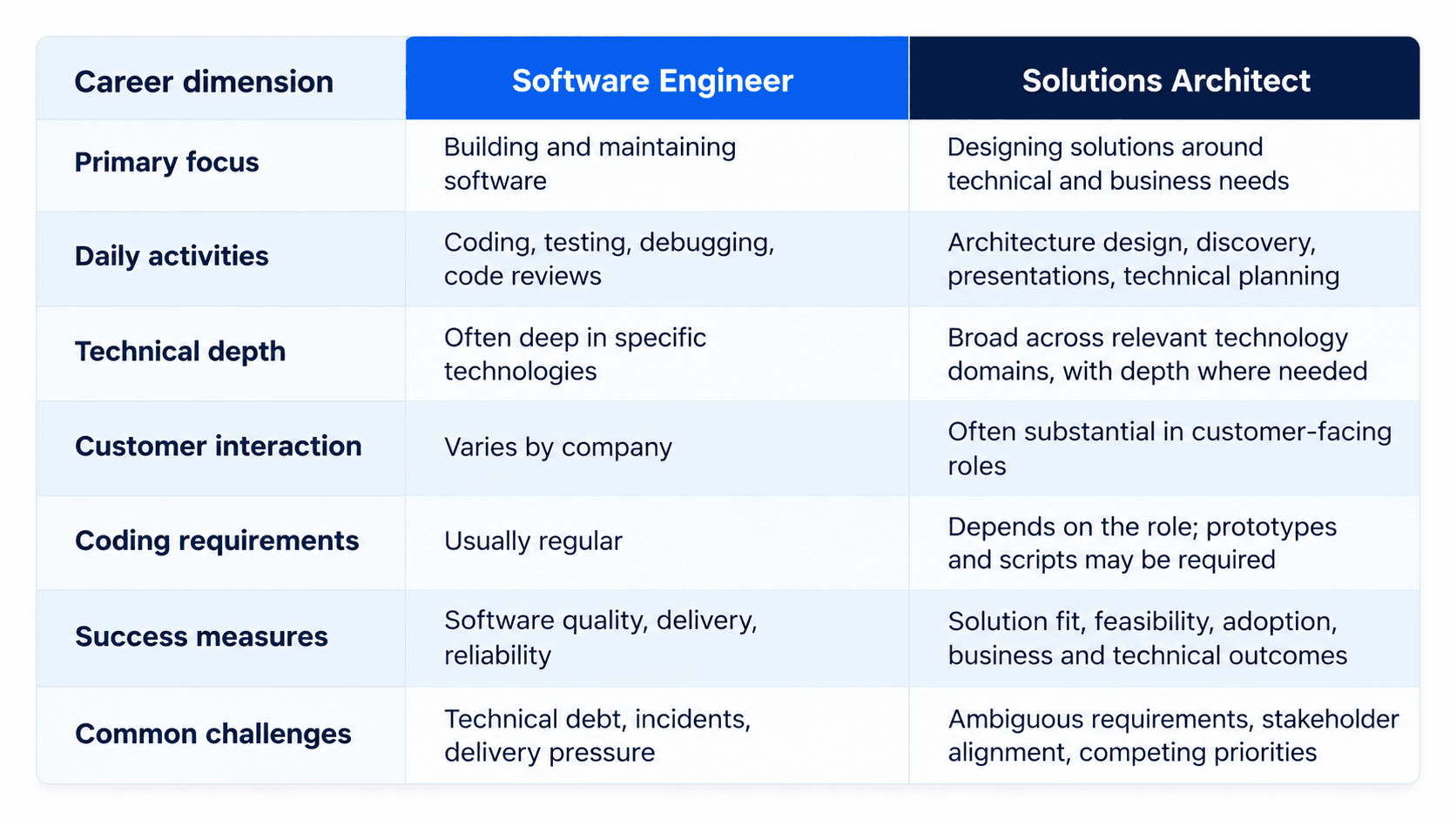
Neither role is universally better. Software engineering may suit people who prefer hands-on implementation, while solutions architecture may appeal to those who enjoy system-level thinking and technical communication.
Before changing careers, review actual job descriptions rather than relying on job titles alone.
4. Enterprise Solutions Architect Skills Checklist
To make a successful transition, build skills across four areas: technical breadth, architectural reasoning, communication, and business awareness.
A. Cloud infrastructure and architecture
Start with the cloud platform most relevant to your target jobs: Amazon Web Services (AWS), Microsoft Azure, or Google Cloud.
Learn the fundamentals of:
Networking, virtual private clouds, subnets, routing, and connectivity.
Identity and access management.
Compute, storage, databases, and managed services.
Containers, Kubernetes, and serverless architectures.
Monitoring, disaster recovery, and high availability.
Infrastructure as code using tools such as Terraform.
You do not need to master every cloud service before applying. Focus on explaining why you would select one architecture over another and what trade-offs each choice introduces.
B. Security, reliability, and data
Architects must consider how systems behave beyond the happy path.
Build familiarity with authentication, authorization, encryption, least-privilege access, backups, observability, and incident recovery.
Understand when relational databases, NoSQL databases, caching systems, and event-streaming platforms are appropriate.
You should also recognize when regulatory requirements apply. Frameworks such as ISO 27001, SOC 2, GDPR, and HIPAA have different purposes and applicability; avoid treating them as interchangeable certifications.
C. Communication and customer discovery
Technical expertise alone does not make someone an effective customer-facing architect.
Learn to ask questions that uncover the actual problem before proposing a solution.
For example, instead of immediately recommending Kubernetes, ask:
What problem is the existing deployment process creating?
What availability and recovery targets are required?
How much traffic does the application handle?
What operational skills does the team already have?
What budget and delivery constraints must the design respect?
These questions help prevent overengineering and make your recommendations more relevant.
D. Business and financial reasoning
Architectural decisions have financial consequences.
Learn to compare total cost of ownership, infrastructure expenditure, operational effort, migration costs, and expected business benefits.
For example, a managed service may reduce operational responsibilities but cost more than a self-managed alternative. The right recommendation depends on the organization's requirements, skills, and budget.
An effective architect explains these trade-offs clearly rather than presenting the most technically sophisticated option as the automatic winner.
5. Solutions Architect vs. Software Engineer Salary
Compensation is an important consideration when evaluating a career change, but there is no universal salary winner.
Software engineer salaries vary by seniority, specialization, location, company size, and equity. Solutions Architect compensation also depends on whether the position is internal, consulting-focused, or associated with presales.
Customer-facing presales roles may use on-target earnings (OTE), which combines base salary with target variable compensation. Other Solutions Architect positions may primarily offer fixed salaries and annual bonuses.
When comparing opportunities, evaluate:
Guaranteed base salary.
Target bonus or sales-linked variable compensation.
Equity and vesting conditions.
Whether variable compensation depends on individual or team results.
Benefits, travel expectations, and working hours.
Career progression and the value of the experience gained.
OTE is not the same as guaranteed income. Variable compensation can depend on sales performance, territory conditions, quota design, and company policies.
Compare current job offers and salary data for your location and experience level before assuming a transition will increase your earnings.
6. Your 90-Day Software Engineer to Solutions Architect Transition Roadmap
A structured plan can help you develop relevant skills while continuing your current job. The following roadmap is a practical starting point, not a guarantee of employment within 90 days.
Days 1–30: Build architectural foundations
Choose a target role and examine 10–15 relevant job descriptions. Identify recurring cloud platforms, architectural skills, certifications, and communication requirements.
Next, select one cloud platform and design a small end-to-end application architecture.
For example, create a design for an e-commerce application that includes a web frontend, API layer, database, authentication, monitoring, and backup strategy.
Document why you selected each component, the main security considerations, estimated cost drivers, and possible failure scenarios.
If a certification aligns with your target jobs, begin preparing for it. Certifications such as AWS Certified Solutions Architect – Associate or Google Cloud Associate Cloud Engineer may provide a foundation. More advanced professional certifications can follow when appropriate.
Days 31–60: Build practical proof of your skills
Turn your design into a portfolio project.
Your project should include:
A clearly labelled architecture diagram.
A written explanation of requirements and assumptions.
Infrastructure-as-code examples where appropriate.
A security and reliability checklist.
A basic cost estimate.
A short demonstration or recorded walkthrough.
If possible, ask a Solutions Architect or Sales Engineer at your company to explain their responsibilities or allow you to observe an appropriate customer-facing activity.
Practice explaining the same design to two audiences: an engineering team interested in implementation details and a business stakeholder interested in cost, risk, and outcomes.
Days 61–90: Prepare for interviews and applications
Rewrite your résumé to show architectural thinking and measurable results.
Instead of writing, "Developed REST APIs using Java," explain the outcome where you can substantiate it: "Designed and implemented REST APIs supporting the integration of three internal services."
Use real metrics only when you have evidence for them. Do not invent cost savings, traffic improvements, or business impact.
Prepare for three common interview areas:
System design: Explain architecture choices, scalability, reliability, security, and trade-offs.
Customer discovery: Ask clarifying questions before proposing a solution.
Behavioral interviews: Demonstrate communication, collaboration, conflict resolution, and sound technical judgment.
Apply to roles that match your current experience. Associate, junior, internal-transfer, and customer-facing technical positions may offer different entry points depending on your background.
7. Common Mistakes to Avoid During the Transition
Mistake 1: Collecting certifications without practical experience
Certifications can demonstrate knowledge, but they do not automatically prove that you can design, explain, or evaluate a real architecture.
Pair learning with projects, diagrams, and decision-making exercises.
Mistake 2: Recommending technology before understanding the problem
A customer does not necessarily need microservices, Kubernetes, or a multi-cloud environment.
Start with requirements and constraints. Recommend the simplest architecture that meets the stated needs, while accounting for future growth where justified.
Mistake 3: Ignoring communication skills
Architects often need to explain difficult trade-offs to people who have different priorities and technical backgrounds.
Practice concise explanations, active listening, presentation skills, and structured documentation.
Mistake 4: Assuming every Solutions Architect role is the same
A cloud provider's presales architect, a consulting architect, and an internal enterprise architect may have significantly different responsibilities.
Read the job description carefully and ask about customer interaction, coding expectations, travel, sales targets, implementation ownership, and on-call responsibilities.
8. Frequently Asked Questions
Do Solutions Architects need to know how to code?
Coding expectations vary by role. Many positions benefit from the ability to read code, understand APIs, write scripts, and build prototypes. Some require substantial hands-on development, while others emphasize architecture, consultation, and stakeholder communication.
How do I become a cloud Solutions Architect?
Start by learning cloud fundamentals, networking, security, databases, and system design. Build practical projects, document your architectural decisions, consider a relevant certification, and gain experience with real technical requirements. Apply for positions that match your existing experience.
What is the difference between a Solutions Architect and a Sales Engineer?
The titles overlap in many organizations. Sales Engineers often focus on technical demonstrations, customer evaluation, and supporting sales opportunities. Solutions Architects may focus more broadly on solution design and architecture. Actual responsibilities vary, so compare the role descriptions rather than relying on titles.
Do Solutions Architects have to travel?
Some positions are fully remote or primarily virtual, while others involve customer visits, workshops, and industry events. Travel depends on the employer, customer base, geography, and role. Ask about expected travel during the interview process.
Can I return to software engineering after becoming a Solutions Architect?
Yes. The transition does not necessarily close the door to engineering. However, keeping coding skills current and remaining involved in implementation can make a later return easier. Possible career directions depend on your experience and the responsibilities of your architecture role.
Is Solutions Architecture a good career for senior developers?
It can be a strong option for senior developers who enjoy system design, cross-functional collaboration, customer problem-solving, and technical communication. Developers who strongly prefer continuous hands-on coding may find a Staff or Principal Engineer path more suitable.
Conclusion: Make the Transition With a Clear Plan
Moving from software engineering to solutions architecture is a shift in how you apply technical expertise, not simply a change in job title.
Your engineering background gives you a useful foundation. To become a competitive candidate, build architectural breadth, understand cloud and security fundamentals, practice customer discovery, and learn to explain technical decisions in business terms.
Start with a focused 90-day plan, create a portfolio that demonstrates your thinking, and compare actual job requirements before committing to a career change.
For more guidance, explore the UNIBLIP Career Change Hub for practical resources on career transitions, professional development, and long-term career planning.
Editorial note: Salary, responsibilities, certification requirements, and hiring expectations vary by company, location, and experience. Verify current role requirements and compensation before making career decisions.